


Key Takeaways
1. Four garage door styles cover nearly every Ontario garage door, such as traditional raised-panel, carriage house, contemporary flush panel, and full-view glass-and-aluminum.
2. The right garage door comes down to your home’s architecture, how much freeze-thaw and road salt it has to survive, how much light or curb appeal you want, and your budget.
3. Anchor Doors makes this easier, with free estimates, showroom appointments, and a full lineup of residential and commercial doors built to hold up through an Ontario winter.
Which Garage Door Style Fits Your Home?
There are four garage door styles that work best in Ontario, and they are:
- Traditional raised-panel steel
- Carriage house
- Contemporary flush panel
- Full-view glass-and-aluminum
| Style | Best For | Ontario Climate Fit | Typical Material |
|---|---|---|---|
| Traditional raised-panel | Colonial and traditional subdivision homes | Solid, resale-friendly; needs a polyurethane core for winter use | Insulated steel |
| Carriage house | Craftsman, farmhouse, century homes | Steel/composite versions resist warping better than real wood | Steel, composite, or cedar overlay |
| Contemporary flush panel | New builds, modern farmhouse | Flat surface sheds snow well when insulated | Steel or aluminum |
| Full-view glass & aluminum | Contemporary architecture, street-facing garages | Needs a winter-rated glazing package; aluminum resists road salt corrosion | Aluminum frame with glass/acrylic infill |
Here’s a closer look at each one, including where it tends to fall short if you’re not paying attention.
Traditional Raised-Panel
Traditional raised-panel is the door most Ontario subdivisions were built with between the 1980s and 2010s: rectangular panels arranged two or three across, usually in white, almond, or a woodgrain laminate.
Nothing about it stands out, and for a colonial or traditional two-story home headed toward resale, that’s the point. The detail worth getting right is the core: a polyurethane-backed steel door holds up through an Ontario winter; a hollow one doesn’t.
- Pros. The lowest cost per square foot of any style here, broad resale appeal since most buyers already recognize the look, and parts/service are easy to find, since it’s the most common style installed
- Cons. The least distinctive option if curb appeal is a priority, and the upgrade from a hollow-core to a polyurethane-backed door adds cost that’s easy to skip past without asking
Carriage House (Carriage-Style)
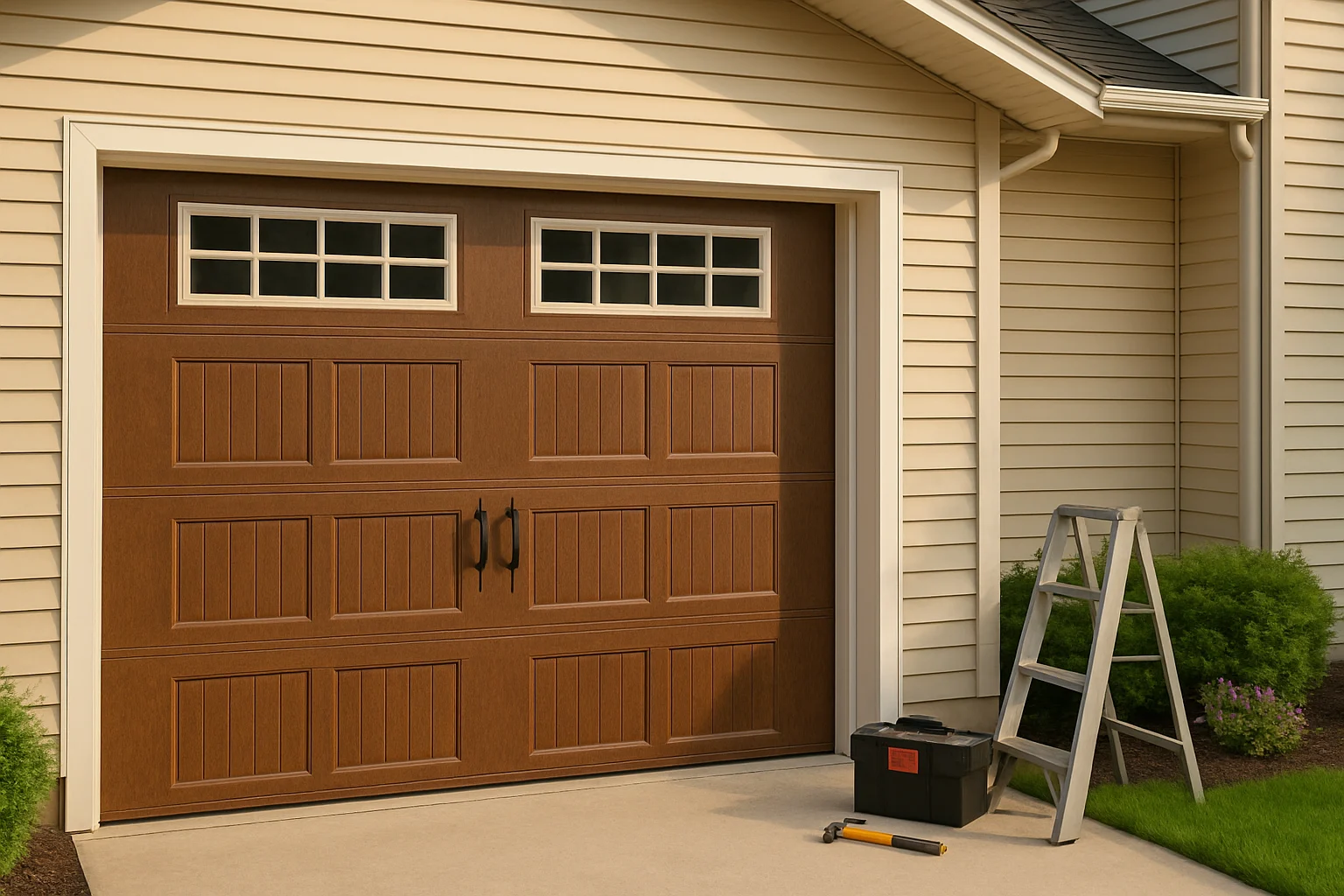
Carriage house doors borrow their look from old barn and coach-house doors: faux-wood grain, arched or square windows, strap hinges and handles. On a Craftsman home, a farmhouse, or a century home, that detail reads as intentional rather than decorative for its own sake.
Steel or composite beats real wood here; Ontario’s humid summers and wet falls are hard on solid wood, and composite gets the grain look without a refinishing schedule.
- Pros. Adds real architectural character without a full exterior renovation, and steel or composite versions hold up with minimal upkeep compared to real wood
- Cons. Costs more than a plain raised-panel door, and decorative strap hinges and handles need occasional tightening or replacement as they age
Contemporary Flush Panel
Contemporary flush panel doors go the opposite direction: no raised profile, just a smooth surface finished in matte black, charcoal, or dark bronze. They’re showing up on new builds and modern farmhouse exteriors for a reason beyond looks, too.
A flat surface sheds snow more cleanly than a deeply recessed panel design, so it clears faster after a squall.
- Pros. The flat face sheds snow faster than a recessed panel design, and it pairs naturally with newer or modern-farmhouse exteriors
- Cons. Dark matte finishes show water spots and dust more visibly than lighter colors, and the look reads out of place on a traditional subdivision home
Full-View Glass and Aluminum
Full-view is the outlier on this list, built from an anodized aluminum frame with glass or acrylic infill instead of solid steel sections. Anchor’s full-view garage door line follows this format, with Custom, Wide, and Narrow profile options and a choice between the ArmorBrite finish system (more than 180 colors) and seven standard anodized tones.
- Pros. Brings in natural light that other styles can’t, gives a genuinely modern look, and the anodized aluminum frame resists the road-salt corrosion that eats away at painted steel
- Cons. It’s the most expensive style on this list, offers less privacy and security than a solid steel door, and an uninsulated or poorly rated glazing package performs badly once temperatures drop
Maintaining Each Garage Door Style Through an Ontario Winter
Each style holds up differently once winter actually arrives, and a few minutes of seasonal upkeep go a long way regardless of which one you choose.
- Traditional raised-panel. Check the weatherstripping at the base and sides each fall; a gap that seems minor in October lets in drafts and slush by January.
- Carriage house. Decorative hardware, especially strap hinges, can loosen with repeated freeze-thaw cycling, so a quick tightening check each spring keeps it from rattling loose.
- Contemporary flush panel. The flat surface sheds snow well, but a dark finish should be rinsed of road-salt buildup periodically rather than left to sit through repeated freeze-thaw cycles.
- Full-view glass and aluminum. Check the glazing seals each fall for gaps, since a failed seal on this style loses heat faster than a solid panel door would, and wipe down the aluminum frame occasionally to keep road-salt residue from settling into the seams.
Budget-Friendly Garage Door Upgrades That Make a Big Difference
How Ontario’s Climate Shapes the Right Garage Door Style
Southwestern Ontario doesn’t get one kind of winter weather; it gets several in the same week.
Homes in the Windsor-Essex and Chatham-Kent region, where Anchor Doors runs its Tecumseh and Chatham showrooms, sit close enough to Lake Erie and Lake St. Clair to catch lake-effect snow squalls, then thaw out days later when a warm front moves through. Two things do most of the damage over time:
- Freeze-thaw cycling. This is harder on a garage door than a steady cold snap; the constant expansion and contraction loosen joints, weatherstripping, and hardware faster than a door would wear in a steadier climate.
- Road salt exposure. Passing traffic and plows throw salt spray onto the bottom third of the door and into the seams between panels, which is where damage shows up first. Untreated steel starts rusting along those seams within a couple of winters, and paint that is not factory-cured lifts and peels once moisture works underneath it.
Matching Garage Door Style to Your Home’s Architecture
A door that looks great in a catalog photo can still look wrong on your house if it doesn’t match the roofline, trim, and window style. It’s worth getting right because the garage door is usually the single largest feature on a home’s street-facing wall.
On many single-garage layouts, it covers more square footage than the front door and windows combined.
Hence, a mismatched style stands out immediately, even to someone who couldn’t say exactly why the house looks a little off. This pairing works as a starting point, not a rule:
| Home Style | Recommended Garage Door Style |
|---|---|
| Colonial or traditional two-storey | Raised-panel with 6- or 8-lite windows |
| Craftsman or bungalow | Carriage house with square windows, dark or wood-tone finish |
| Modern farmhouse | Flush panel or carriage house in black, minimal hardware |
| Contemporary or new build | Full-view aluminum and glass, or a plain flush panel |
| Century or heritage home | Carriage house with cedar overlay and decorative hardware |
Modern Garage Door Styles Gaining Ground in Ontario Neighborhoods
A few shifts show up again and again in newer Ontario builds and renovations, in the finish, the materials, the hardware, and even the reasoning behind the choice. Here’s what’s actually driving each one.
Dark, Matte Finishes Are Becoming the Default
Dark, matte finishes, especially black and dark bronze, have replaced white as the default on new-build flush panel and carriage house doors. New subdivisions are following the same trend, showing up everywhere else on the outside of a house: black windows, black eavestroughs, dark front doors.
Dark finishes also hide road-salt residue and water spots better than white does between washes, which matters more here than in a drier climate. Homeowners updating an older white door before selling tend to choose dark for the same reason: it looks like a real upgrade, not just a fresh coat of the same color.
Full-View Aluminum, Bolder Windows, and Simpler Hardware
Full-view aluminum has moved out of strictly commercial buildings and onto residential streets, mostly on homes with a contemporary look or a converted garage. Part of the reason is that more homeowners are turning garages into usable space, like a studio or gym, and a full-view door brings in daylight the way a wall of windows would.
Window choices have gotten bolder, too, with wider 4-over-4 or 4-pane arched rows replacing small individual lites, since bigger garage doors on newer homes look unbalanced next to small, evenly spaced windows.
Hardware has moved the other way, toward one simple handle instead of the heavier strap-hinge look popular a decade ago; that heavier look was tied to the farmhouse trend, which has cooled off in favor of cleaner lines, and it also means fewer metal parts exposed to Ontario winters.
The Resale Value Angle
Style choice also has a financial angle. In the U.S., where this kind of resale data is tracked most closely, Zonda’s 2025 Cost vs. Value Report ranked garage door replacement as the top-recouping home improvement project nationally for the second year running, with homeowners recovering 267.7% of the project’s cost at resale, the highest return of any project measured.
Canadian resale data isn’t tracked with the same granularity, but the underlying reason likely carries over: a garage door is one of the largest visible surfaces on a home’s exterior, and it’s one of the first things a buyer notices, whether they’re touring a house in Ohio or Ontario.
Choosing Colors and Materials That Hold Up to Ontario Winters
Road salt is the real threat. It splashes up from tires, sits in snowbanks against your driveway, and hits the door every time crews plow. Add freeze-thaw cycling and weak finishes, and you get pitting, chalking, or rust within a few seasons instead of lasting a decade. The right material now means no repainting or rust repair later.
- Anodized aluminum. Anodized aluminum finishes (clear, champagne, bronze tones, black) resist the fading and pitting that road salt causes over a few winters, though that durability comes from the full-view aluminum-and-glass style specifically, which trades off privacy and security compared to a solid steel door. It’s the right call if salt resistance and natural light matter more than those two things; otherwise, a galvanized steel door with a factory finish gets most of the same salt resistance without the tradeoff.
- Galvanized steel with a factory powder coat. Holds up better than field-painted steel where salt spray is constant, with no repainting or rust repair later. Ask your installer whether the door was painted at the factory or touched up on-site.
- Dark finishes. Absorb more heat on sunny days, which can speed up snowmelt on the door face and refreeze overnight. Cosmetic, not structural, but worth knowing for a north-facing door.
- Composite and cedar-overlay doors. Look great but require upkeep; check the warranty before you buy. Some require annual sealing or refinishing, and skipping it can void coverage.
| Material/Finish | Best For | Watch Out For |
|---|---|---|
| Anodized aluminum | Long-term salt resistance, low upkeep, natural light (full-view doors) | Less privacy and security than a solid steel door |
| Galvanized steel, factory powder-coated | High-traffic driveways, heavy salt exposure | Confirm it’s factory-applied field touched up paint ages faster |
| Dark colors | Curb appeal | Snowmelt/refreeze on north-facing doors |
| Composite/cedar-overlay | Wood look, less upkeep than solid wood | Warranty may require annual sealing or refinishing |
Common Style Mistakes Ontario Homeowners Make
Most homeowners only buy a garage door once, maybe twice, and the door sits on the front of the house for years afterward. That’s a lot riding on one decision, and it’s easy to get wrong. Below are the mistakes we see most often, along with what they end up costing.
- Choosing a style from a photo without checking proportions. A carriage house door with heavy windows and hardware can look busy on a narrow single-car opening, and a full-view door sized for a two-car garage can overwhelm a small bungalow.
- Picking white or another light color without expecting the upkeep. Light finishes show road salt and grime faster than dark ones, and end up getting power-washed more often as a result.
- Assuming a stock size will fit an older opening. Century and heritage homes especially often have openings slightly off from modern standard sizes, and a custom or adjusted order avoids the gaps that let in drafts and pests.
- Choosing a style before confirming insulation. A full-view door looks great on an attached, heated garage, but an uninsulated or poorly rated glazing package can turn that choice into a real heating-bill problem by January.
- Not asking what the warranty actually requires. Composite and wood-overlay doors look low-maintenance in the showroom, but skipping a required annual sealing step can void coverage on a door that then weathers badly.
Choose Your Garage Door Style with Anchor Doors
The right garage door style looks sharp and works properly after several winters, not just on installation day. If you’re torn between two styles that both suit your home’s architecture, let the driveway settle it: a north-facing entry that never fully dries between storms is worth the extra cost for a corrosion-resistant finish. From here, work through the details in this order:
- Narrow your style choice down to one or two options using the architecture table above, rather than starting from a color you like.
- Match the insulation rating and glazing package to how the garage is actually used, especially if it’s attached, heated, or sits under living space.
- Reach out to Anchor Doors for a free estimate to see residential garage doors and glass options in person before you sign off on one.
Ready to move forward? Request a free estimate or book a showroom appointment at Anchor Doors’ Tecumseh or Chatham location to see finishes and glass options up close.